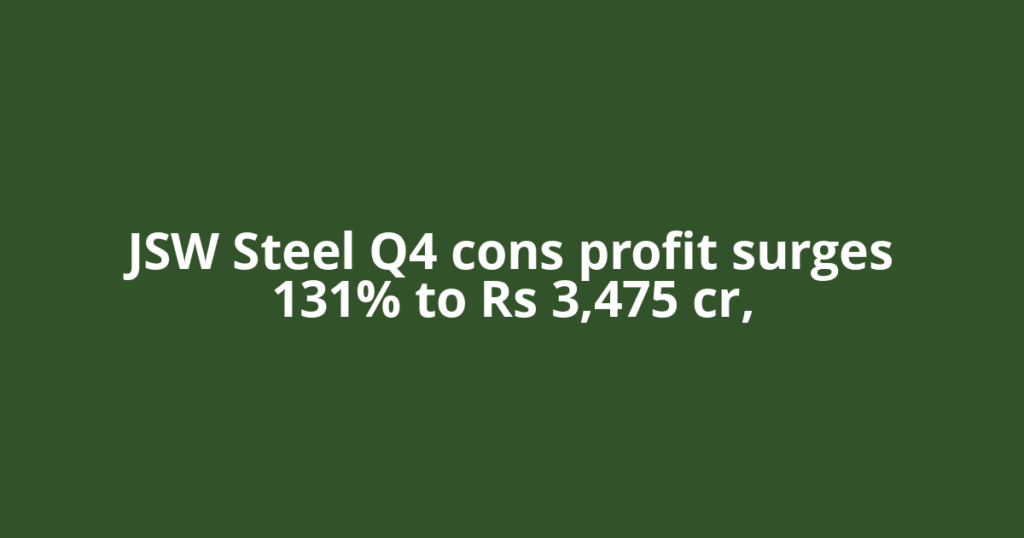
JSW Steel Q4 Profit Surges 131% to Rs 3,475 Crore, Revenue Rises 14%
JSW Steel, one of India’s leading steel manufacturers, has reported a massive jump in its consolidated net profit for the January-March quarter of the financial year 2026. The company’s net profit surged by 131% to Rs 3,475 crore compared to the same period last year. This marks a strong recovery for the steel giant, which had faced headwinds in previous quarters due to global economic uncertainty and fluctuating raw material costs.
The company’s revenue from operations also showed healthy growth. It rose by 14% year-on-year to reach Rs 51,180 crore for the fourth quarter. This increase was driven by higher sales volumes and better realizations in the domestic market. JSW Steel’s performance reflects the overall strength of India’s steel sector, which has benefited from strong demand from infrastructure, automotive, and construction industries.
What Drove the Profit Surge?
The sharp rise in profit was primarily due to improved operational efficiency and lower input costs. Steelmakers across the world faced high coking coal and iron ore prices in earlier quarters. However, in Q4FY26, these costs moderated, allowing JSW Steel to expand its margins. The company also benefited from a favorable product mix, with higher sales of value-added steel products that fetch better prices.
Additionally, JSW Steel’s focus on cost reduction and capacity utilization played a key role. The company operated its plants at near-full capacity, which helped spread fixed costs over a larger production volume. This is a common strategy in the steel industry to boost profitability when demand is strong.
Revenue Growth Supported by Strong Demand
The 14% rise in revenue was supported by robust domestic demand. India’s steel consumption has been growing steadily, driven by government spending on roads, bridges, and housing. The automotive sector also picked up, with increased production of cars and commercial vehicles. JSW Steel, being a major supplier to these industries, directly benefited from this trend.
For example, the company’s sales to the automotive segment rose by over 20% during the quarter. Similarly, demand from the renewable energy sector, particularly for wind and solar projects, added to the revenue growth. JSW Steel has been actively expanding its product portfolio to cater to these emerging sectors.
Context and Industry Background
The steel industry is cyclical and sensitive to global economic conditions. In the past two years, steel prices had softened due to a slowdown in China and trade tensions. However, India’s steel market remained relatively insulated due to strong domestic demand. JSW Steel’s Q4 results are a clear indicator that the company is well-positioned to capitalize on this trend.
Analysts point out that the company’s net profit of Rs 3,475 crore is a significant improvement from the Rs 1,503 crore reported in the same quarter last year. This represents a growth of over 130%. The company’s EBITDA (earnings before interest, tax, depreciation, and amortization) also improved, reflecting better cash generation.
What This Means for Investors
For general investors, JSW Steel’s strong quarterly performance is a positive signal. It suggests that the company is managing costs well and benefiting from favorable market conditions. However, investors should also be aware of risks. Steel prices can be volatile, and any sudden drop in demand or rise in input costs could impact future profits.
JSW Steel’s management has expressed confidence in the coming quarters. They expect demand to remain strong due to continued government spending on infrastructure and a recovery in the global economy. The company also plans to increase its production capacity in the next few years, which could further boost revenue and profits.
In summary, JSW Steel’s Q4 results show a company in good health. The 131% profit surge and 14% revenue growth are impressive numbers. Investors should watch for sustained demand and cost management in the coming quarters to gauge the company’s long-term performance.